My “Sponge Property”: Adaptation Measures on Private Property to Improve the Built Environment’s Resilience to Stormwater Flooding
You are here : Home > Research at AdapT > My “Sponge Property”: Adaptation Measures on Private Property to Improve the Built Environment’s Resilience to Stormwater Flooding
FRQ-AdapT Chair
Description
The Greater Montreal area is facing an increase in the intensity and frequency of extreme rainfall events, a direct consequence of climate change. Since 2022, 100-year return period rain events have occurred every year, exceeding the capacity of drainage systems that are not designed to handle such extremes and causing major flooding, particularly in low-lying areas where water accumulates. To improve the resilience of the built environment, stormwater management strategies are already proving effective. These include green and blue infrastructure, such as rain gardens, permeable paving, and green or blue roofs. In addition to reducing runoff, they contribute to biodiversity and help mitigate heat islands. However, these strategies are primarily implemented on public land, limiting their impact.
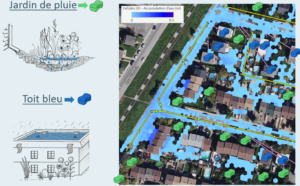
1D-2D Modeling with PCSWMM: Proposed Conditions Using IVB on Private Property
This project aims to promote and facilitate the adoption of these measures on private property in order to better control runoff at its source in vulnerable areas. To achieve this, a case study was conducted on topographic basins in two partner cities involved in the project: Longueuil and Montreal.
The project also analyzes the implementation and coordination challenges involved in effectively engaging municipalities and property owners, raising their awareness of flash floods, and promoting the adoption of solutions to build resilience to extreme rainfall.
Objectives
Reduce the risk of flooding in buildings located in topographic basins;
Quantify the impact of implementing green and blue infrastructure (GBI) on private land.
Related projects
Research chair
FRQ-AdapT :Research Chair: Resilient management of stormwater runoff in urban and rural environments
Gestion de l’eau
Eaux usées
Matériaux durables
Infrastructures vertes
Learn more →
Finished
Rainwater management using sponge parks: case study of Prieur Park
Inondations
Gestion de l’eau
Approvisionnement et résilience
Infrastructures vertes
Learn more →
Finished
Impacts of densification on municipal water infrastructure
Inondations
Gestion de l’eau
Approvisionnement et résilience
Eaux usées
Infrastructures vertes
Learn more →
On going
Large-scale mapping of storm flood hazards tailored to available data
Inondations
Gestion de l’eau
Learn more →
Don’t just coexist with climate change.
Get concrete, achievable solutions with the Institut AdapT!
To provide the best experiences, we use technologies like cookies to store and/or access device information. Consenting to these technologies will allow us to process data such as browsing behavior or unique IDs on this site. Not consenting or withdrawing consent, may adversely affect certain features and functions.
Functional
Always active
The technical storage or access is strictly necessary for the legitimate purpose of enabling the use of a specific service explicitly requested by the subscriber or user, or for the sole purpose of carrying out the transmission of a communication over an electronic communications network.
Preferences
The technical storage or access is necessary for the legitimate purpose of storing preferences that are not requested by the subscriber or user.
Statistics
The technical storage or access that is used exclusively for statistical purposes.The technical storage or access that is used exclusively for anonymous statistical purposes. Without a subpoena, voluntary compliance on the part of your Internet Service Provider, or additional records from a third party, information stored or retrieved for this purpose alone cannot usually be used to identify you.
Marketing
The technical storage or access is required to create user profiles to send advertising, or to track the user on a website or across several websites for similar marketing purposes.